

In talking with some friends recently, and seeing headlines lately, there’s quite a few people getting sick unexpectedly, some very seriously. How do we handle this as friends, as a society? is there something we can do to help people prevent and protect their families and themselves? There are so many factors involved in keeping us healthy or by which we become health challenged.
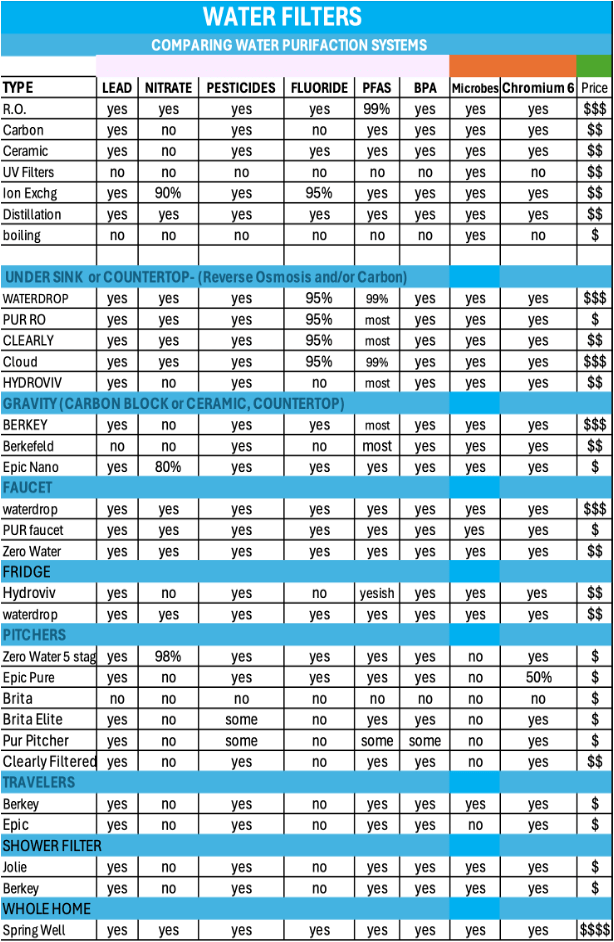
In life there are no guarantees for anything. The sun rises and the sun sets and what happens in between is a miracle. Our lives and our health are fragile. If there’s anything we can do to bolster and guard our health I believe it is found in the thoughts we think, the air we breathe, the water we drink, the way we grow our food and the nutrients we absorb. My purpose in writing is to add value to you and your life, and hopefully help raise our health frequency in the process. To that end, I share this chapter from my latest book, Filter Your Water Now!, a title that speaks of the urgency of our current situation. ‘Health Wake up Call’ is found in the introductory section. Also included below is the water filter comparison chart I created rating various types of filters that you can install in your home.
Health Wake Up Call
According the United Nations, 2 billion people worldwide lack access to clean and safe drinking water.[i] What’s wrong with us that we allow this? As we unravel the sources and causes for water pollution and scarcity, we will manifest the solutions to solving our expanding health crisis.
Between the pollution and the exposures in our environment, lies the cause for many diseases triggered by factors other than genetics. Most cancer is now known to be the result of factors in our environment. Once we understand the cause, there is great hope for recovery and healing. It’s of the utmost importance that we tackle the sources of pollution now. Whether it’s in the water, air, or our food, the most sinister of pollutants and toxic substances must be withdrawn from use.
Today’s Health Emergencies include:
- Rising rates of early onset cancer[ii] in adults under 50
- Rising rates of colon cancer and lung cancer
- Rising rates of Alzheimer’s and Dementia
- Rising rates of MS
- Rising rates of PTSD
- Rising rates of antibiotic-resistant diseases
- Rising rates of diabetes and metabolic syndrome
- Rising rates of childhood cancer, autism, and allergies
President’s Cancer Panel Report 2008-2009
“The entire U.S. population is exposed on a daily basis to numerous agricultural chemicals, some of which also are used in residential and commercial landscaping. Many of these chemicals have known or suspected carcinogenic or endocrine-disrupting properties. Pesticides (insecticides, herbicides, and fungicides) approved for use by the U.S. Environmental Protection Agency (EPA) contain nearly 900 active ingredients, many of which are toxic. Many of the solvents, fillers, and other chemicals listed as inert ingredients on pesticide labels also are toxic, but are not required to be tested for their potential to cause chronic diseases such as cancer. In addition to pesticides, agricultural fertilizers and veterinary pharmaceuticals are major contributors to water pollution, both directly and as a result of chemical processes that form toxic by-products when these substances enter the water supply. Farmers and their families, including migrant workers, are at highest risk from agricultural exposures. Because agricultural chemicals often are applied as mixtures, it has been difficult to clearly distinguish cancer risks associated with individual agents.”
“The good news is that a large number of cancers can be prevented. It is estimated that as many as two-thirds of all cancer cases are linked to environmental causes. This number may even be higher. Many of these are linked to lifestyle factors that can be modified.”[iii]
The President’s Cancer Panel Report 2008-2009[iv]
“A precautionary, prevention-oriented approach should replace current reactionary approaches to environmental contaminants in which human harm must be proven before action is taken to reduce or eliminate exposure. Though not applicable in every instance, this approach should be the cornerstone of a new national cancer prevention strategy that emphasizes primary prevention, redirects accordingly both research and policy agendas, and sets tangible goals for reducing or eliminating toxic environmental exposures (that cause cancer).”
SOLUTIONS:
- Filter your water. Avoid toxins in water, in air, and in food.
- Drink and cook with purified water.
- Be a leader and help encourage our elected officials to take action, introduce a bill, whatever it takes to help move the process forward effectively.
- We have no time to lose. We all must help in cleaning up our country’s water resources.
[i] United Nations World Water Development Report 2023, UN, https://unesdoc.unesco.org/ark:/48223/pf0000384657
[ii] “What to Know About Rising Rates of Early Onset Cancer,” Kathy Katella, Yale Medicine, August 1, 2024, https://www.yalemedicine.org/news/early-onset-cancer-in-younger-people-on-the-rise
[iii] Cancer and the Environment, What You Need to Know, National Institutes of Health, August 2003, https://www.niehs.nih.gov/health/materials/cancer_and_the_environment_508.pdf
[iv] Reducing Environmental Cancer Risk, President’s Cancer Panel Annual Report 2008-2009, https://deainfo.nci.nih.gov/advisory/pcp/annualreports/pcp08-09rpt/pcp_report_08-09_508.pdf
Remember, any filter is better than none at all.
Discover more from Wecologist
Subscribe to get the latest posts sent to your email.
